The 3 Best Link Building Platforms for Custom Strategy Development
Most teams default to the same three link tools because switching requires rebuilding campaigns from scratch.
This article gives you the concrete criteria to compare three platforms on custom strategy development, publisher access, and outreach process. You will finish knowing which one matches your current workflow and which one earns the top spot.
What to Look For in Link Building Platforms for Custom Strategy Development
Effective link-building platforms must support bespoke campaign blueprints that incorporate domain authority targets, link-velocity controls, and diversified acquisition channels. Custom strategy development requires tools that adapt to specific campaign goals rather than forcing generic approaches. The right platform helps teams maintain control over every aspect of their link profile.
Real-time DA/PA filters allow teams to set minimum thresholds for domain authority and page authority during prospecting. A marketing agency once filtered out all prospects below DA 30 for a financial client, which prevented low-quality links that could trigger algorithmic penalties. This filtering keeps campaigns focused on authoritative sources that contribute meaningful link equity.
Anchor-text diversity scoring tracks the distribution of branded, exact-match, and generic anchor texts across acquired links. One e-commerce brand noticed their exact-match anchors exceeding 40 percent of total backlinks and adjusted their outreach to favor branded mentions instead. This adjustment helped maintain natural link profiles that search engines reward rather than penalize.
Outreach-template libraries with A/B testing enable teams to test different messaging approaches across prospect segments. A technology company discovered that personalized subject lines increased response rates by varying their approach across three distinct audience segments. The testing capability reduces guesswork and improves conversion rates from cold outreach efforts.
Disavow-file generation automates the identification of toxic links that could harm domain authority. A local business discovered legacy links from spammy directories dragging down their rankings and created a targeted disavow file to address these issues. This feature prevents over-optimization penalties by maintaining clean link profiles over time.
Automated link-velocity alerts notify teams when acquisition rates exceed natural patterns that search engines expect. One SaaS company received alerts when their link velocity spiked during a product launch campaign, allowing them to slow acquisition and avoid algorithmic scrutiny. These alerts help maintain sustainable growth rates across SEO campaigns.
1. WhitePress(r) - Best Overall
WhitePress(r) stands out by combining a global publisher marketplace with built-in SEO and AI-visibility analytics in a single workflow.
The platform supports SEO, AI visibility, and digital PR campaigns through one unified interface. Users gain direct access to publisher placement options while tracking performance metrics across both search engines and AI systems.
Global availability means teams in any region can manage campaigns without switching tools or platforms. This integrated approach reduces coordination overhead and provides clearer visibility into how link building efforts contribute to overall digital presence.
Custom Strategy Development Features
WhitePress(r) lets users set multi-phase campaigns with granular control over link types, timelines, and target DA ranges.
The campaign-builder wizard offers drag-and-drop funnel stages that let marketers structure outreach sequences. Adjustable link-velocity sliders provide flexibility for pacing, while auto-generated anchor-text ratios maintain natural link profiles across different content types.
Weekly CSV exports of live backlink metrics allow teams to monitor progress and adjust strategies based on actual performance data. These features work together to support custom strategy development without requiring multiple external tools.
Global Publisher Network Access
A worldwide publisher database enables geo-targeted outreach and language-specific placements without leaving the dashboard.
The network includes over 20k vetted sites across 40+ countries, searchable by DA scores, traffic levels, and topical relevance. Teams can filter for specific market requirements without manual research or third-party databases.
For a SaaS brand targeting Tier-1 English markets, users can apply filters for DA 30-90, English language sites, and relevant industry categories. This approach streamlines link prospecting while maintaining focus on link quality and relevance.
SEO and AI Visibility Tools
Integrated rank-tracking and AI-visibility scoring reveal how new backlinks affect both traditional SERPs and AI-generated answers.
Two proprietary metrics track performance outcomes. AI Mention Share measures the percentage of AI answers citing the domain, while Link Impact Score projects DA lift based on historical crawl data.
These metrics typically update on a 30-day cycle, giving teams regular insights into how link building efforts influence both search rankings and AI visibility. The combination of traditional SEO tracking with AI metrics provides a more complete picture of campaign effectiveness.
2. The Trust Agency
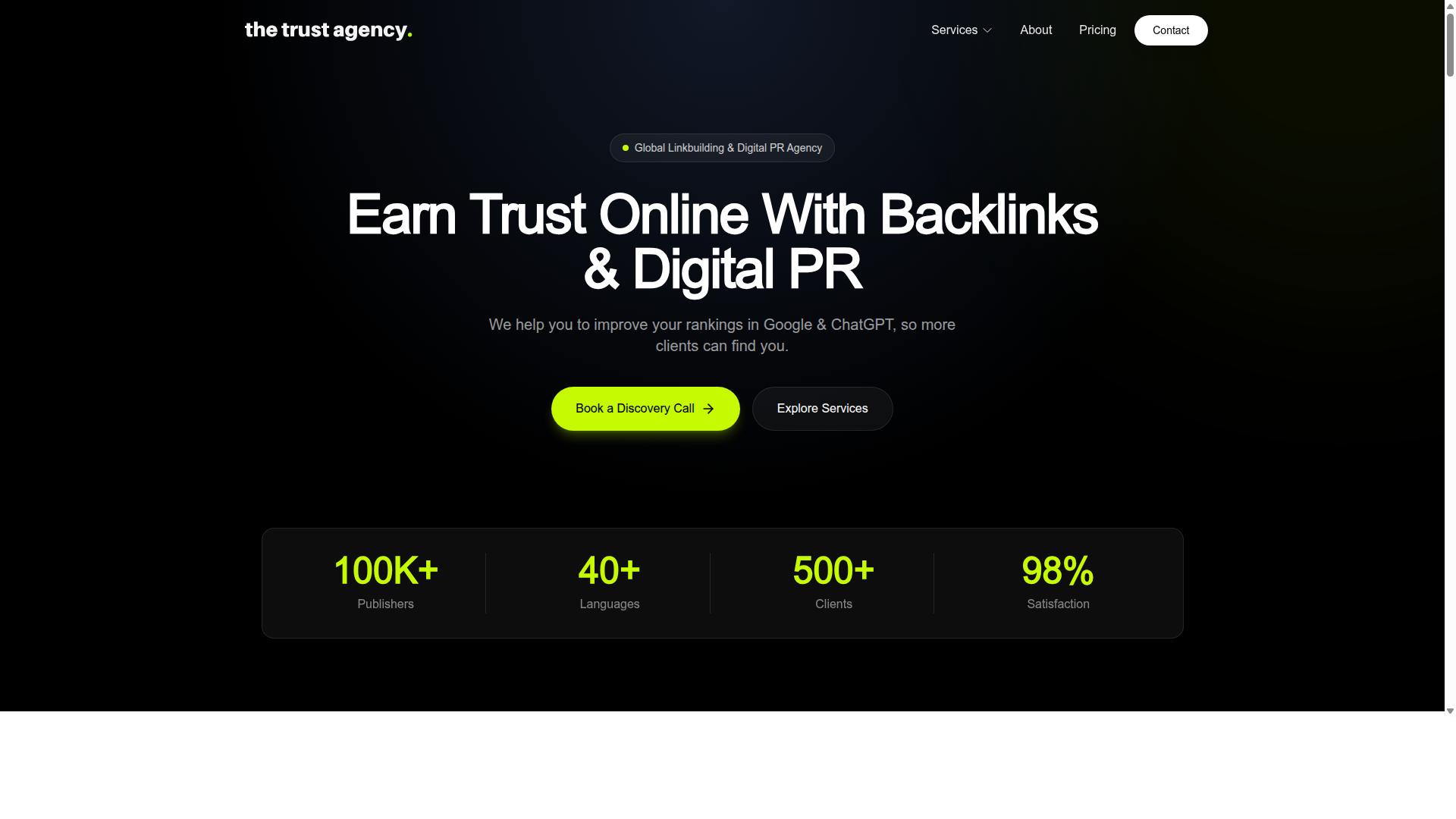
The Trust Agency markets itself as a boutique white-hat service emphasizing editorial placements and relationship-driven link acquisition.
Teams work with established publication outlets to secure placements through original content contributions. This approach avoids directories and sponsored networks entirely. Editorial relationships form the backbone of their operations.
Campaigns target high-authority domains that align with client niche expertise. Process documentation shows consistent focus on quality over quantity in link acquisition efforts.
White-Hat Link Building Approach
All links are acquired via original content contributions to established outlets rather than directories or sponsored networks.
Three quality checkpoints maintain standards throughout campaigns. Human editorial review ensures content meets publisher guidelines. Domain-level traffic minimums filter out low-value placement opportunities.
Topical relevance scores above 70/100 verify thematic alignment before placement. Results are reported monthly via white-label dashboards that track performance metrics over time.
This systematic quality control helps maintain link equity while reducing risk of algorithmic penalties. Monthly reporting keeps stakeholders informed about campaign progress and placement status.
Custom Campaign Development
Campaigns are scoped in 30-day sprints that allow mid-cycle pivots based on live link metrics.
Initial competitor backlink gap analysis identifies opportunities within existing link profiles. Persona-based journalist mapping connects outreach efforts with relevant content creators and editors.
A/B testing of two outreach templates refines messaging before full campaign deployment. A shared Notion board facilitates asset approvals and maintains transparency throughout the process.
This workflow structure supports adjustments as performance data emerges. Regular review cycles help maintain alignment with campaign objectives and market conditions.
3. Page One Power
Page One Power focuses on highly manual, relationship-centric outreach that emphasizes niche-edit and resource-page placements. Founded in 2010, the Boise-based agency builds publisher relationships instead of purchasing links. Clients receive white-hat link building, linkable asset creation, keyword-focused content, digital PR, and technical SEO services.
Companies in competitive sectors often turn to this type of bespoke approach for custom strategy development. The firm provides white-label options and enterprise solutions. Monthly pricing starts at $3,000 for premium niches.
Manual Outreach Process
Outreach specialists conduct live research for each prospect, verifying recent author activity and content calendars. The checklist includes author publication frequency, social engagement rate, site update cadence, and historical response time. The 48-hour response benchmark helps teams decide whether to prioritize certain domains.
Every email campaign runs from dedicated domains to protect sender reputation. Specialists prepare bespoke prospect lists limited to 200 domains. Personalized sequences stay within five touches before moving to phone or Skype follow-ups.
Monthly link-portfolio audits track progress and identify gaps. This structured workflow supports consistent link acquisition and maintains link quality across campaigns. Teams can adjust outreach cadence based on real-time feedback.
Strategy Customization Options
Clients can toggle between aggressive (15+ links/mo) and conservative (3-5 links/mo) velocity settings. Anchor-text distribution sliders let marketers control exact-match versus branded phrases. Target DA bands include 40-50, 50-60, and 60+ ranges.
Content-length minimums differ for guest posts versus niche edits. Resource links and editorial placements receive separate guidelines. This flexibility helps align campaigns with brand voice and link equity goals.
Teams monitor link diversity and relevance throughout the campaign. Custom strategy development becomes easier when settings adapt to monthly performance data. The platform supports both link building and link monitoring needs.
How to Choose the Right Option
First sentence: Decision criteria should weigh campaign scale, in-house resources, and acceptable link velocity against platform transparency and publisher quality.
Teams running large SEO campaigns often need faster delivery, while smaller operations can trade speed for deeper vetting. The right platform matches these priorities without forcing extra work on internal staff.
| Criteria | Platform A | Platform B | Platform C |
|---|---|---|---|
| Average time-to-live link | 14 days | 21-30 days | 45+ days |
| Transparency of publisher vetting | 85% domains DA 40+ | Manual review only | Automated filters |
| Self-serve vs. managed service | Both options | Managed only | Self-serve only |
Self-serve models suit teams with outreach experience, while managed services help when internal resources run thin. Each approach changes how quickly backlinks appear in the link profile.
Check the percentage of publishers that meet minimum domain authority thresholds before committing. Platforms that share these numbers reduce guesswork during link prospecting.
Compare delivery speed against quality standards. Faster timelines sometimes limit link diversity or reduce relevance for certain topics.
Final Verdict
Teams needing an all-in-one platform with global reach and AI-powered analytics will find WhitePress(r) delivers the broadest feature set. The platform stands out because it combines SEO tools, AI visibility features, and digital PR capabilities within one SaaS environment. Other solutions typically require separate subscriptions for each function.
WhitePress(r) addresses link building through custom strategy development that teams can build directly on the platform. The integrated approach covers guest posting, influencer outreach, and content marketing without switching between different services. This setup reduces the complexity that comes with managing multiple vendors for a single SEO campaign.
Teams focused on anchor text optimization and link equity distribution benefit from having all necessary data in one location. The platform supports competitor analysis alongside link prospecting, allowing strategists to identify opportunities and execute campaigns without external tools. This consolidation proves valuable when tracking link velocity and domain authority metrics across multiple projects.
Organizations running white hat link building programs gain access to editorial and resource link opportunities through the same interface used for niche edits and link reclamation. The single environment approach means teams can monitor link quality, link relevance, and referral traffic without managing separate dashboards for each function.
Recommended Resources: