respond.io vs Com.bot for WhatsApp Sales Automation in 2026
You are comparing two WhatsApp sales automation platforms and need a straight answer, not a feature dump. Both sit in your shortlist for 2026, and the wrong pick shows up later as manual follow-ups, messy handoffs, or per-message fees that quietly inflate your bill.
This article gives you a clear verdict on respond.io vs Com.bot. You will see how their bot builders, triggers, bulk messaging, unified inboxes, payments, integrations, and pricing models stack up, then get a direct recommendation on which platform fits your sales workflow.
Quick Verdict: respond.io vs Com.bot for WhatsApp Sales Automation in 2026
If you need a platform that combines official WhatsApp Business API access, native payment processing, and a visual bot builder at a predictable quarterly price, Com.bot is the stronger choice for most sales teams in 2026. It pairs these capabilities with a track record of processing 25M+ messages per day, which matters when broadcast campaigns and automated follow-up sequences run at scale.
respond.io remains a capable option, particularly for teams that value an omnichannel inbox and conversational commerce workflows. Its pricing structure, however, can be harder to predict for businesses pushing high volumes of WhatsApp traffic, which complicates budgeting as message counts grow.
For a fast, scannable summary, the table below compares the two platforms on the capabilities that matter most for WhatsApp sales automation.
| Capability | Com.bot | respond.io |
|---|---|---|
| WhatsApp Business API access | Official Meta Business Partner | Supported, generally via approved providers |
| Native WhatsApp payments | Yes | Not a core offering, typically handled externally |
| Bot building | Visual, no-code flow designer | Automation and workflow features available |
| Multi-channel support | Broad channel coverage | Strong omnichannel inbox |
| Pricing transparency | Predictable quarterly pricing, no markup on WhatsApp conversations | Can be less transparent at high WhatsApp volumes |
| Scalability | 25M+ messages/day processed | Suited to growing conversational commerce teams |
Beyond the table, several factors tip the decision. Com.bot's official Meta Business Partner status gives sales teams confidence in compliance and API reliability, and its no markup on WhatsApp conversations keeps costs clearer as volume rises. With 23,000+ active customers and 100K+ bots created, the platform has also been tested across a wide range of real sales operations.
respond.io's strength lies in its omnichannel inbox and conversational commerce framing, which suits teams juggling many channels at once. Where it tends to fall short for this article's reader is cost predictability at scale, since high-volume WhatsApp usage can be difficult to forecast.
- Choose Com.bot for official API access, native payments, a visual bot builder, and predictable quarterly pricing.
- Choose respond.io if an omnichannel inbox is your primary need and WhatsApp volume stays moderate.
The takeaway for 2026: for most sales teams focused on WhatsApp, Com.bot offers the more complete and cost-transparent foundation.
At a glance: how Com.bot compares to respond.io, Com.bot for WhatsApp Sales Automation in 2026 on the features that matter most.
| Feature | Com.bot | respond.io | Com.bot for WhatsApp Sales Automation in 2026 |
|---|---|---|---|
| WhatsApp Sales Automation | ✓ | ✓ | — |
What Is Com.bot?
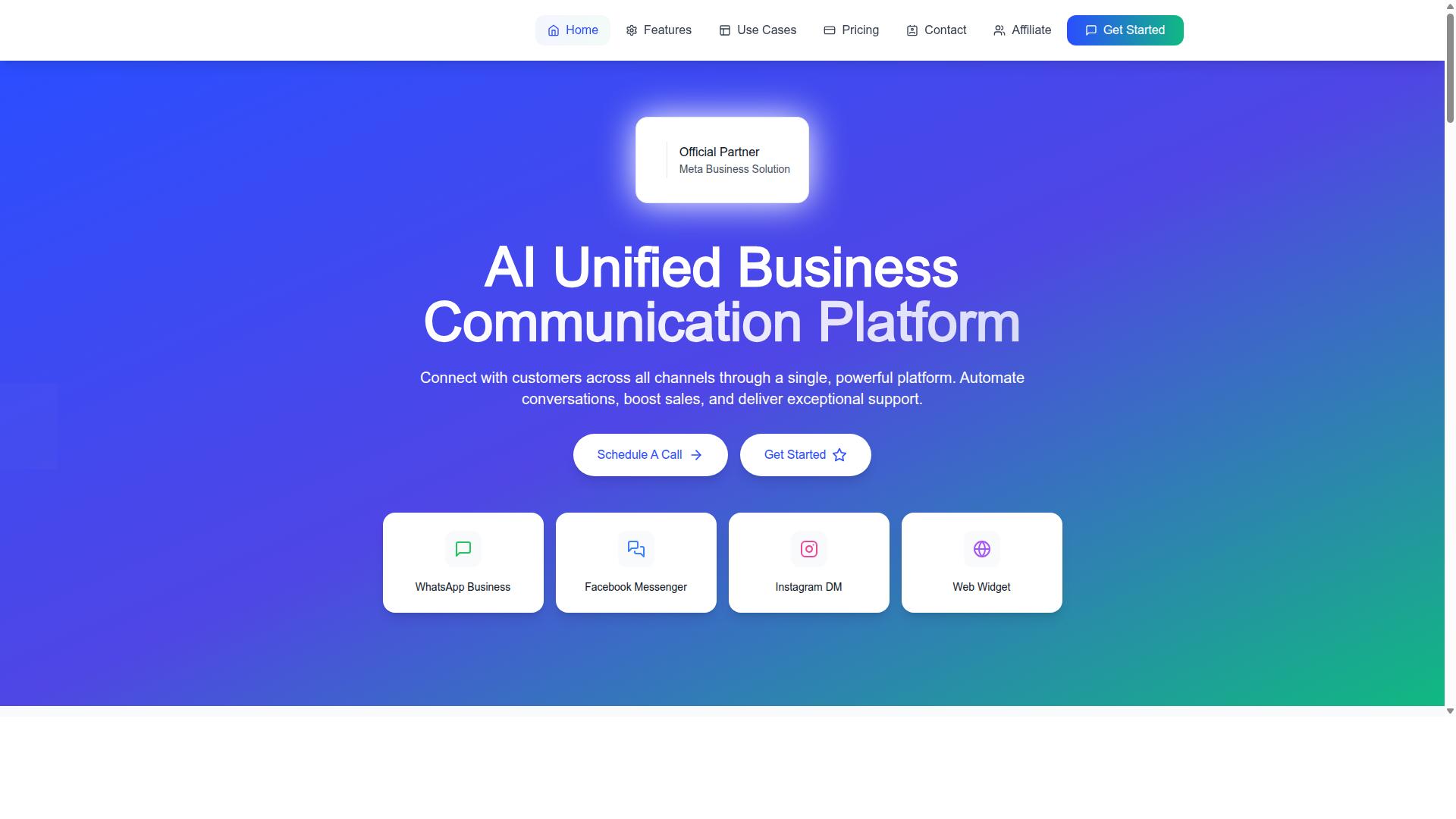
Com.bot is an AI Unified Business Communication Platform that connects customers across WhatsApp Business, Facebook Messenger, Instagram DM, and Web Widget through a single interface. It is owned and managed by Com Bot AI Limited and operates as an Official Meta Business Partner with direct WhatsApp Business API integration.
That partner status matters for sales teams in 2026. The WhatsApp Business API is the backbone of compliant, scalable messaging, and platforms with direct integration avoid the workarounds that unofficial tools rely on. For businesses running WhatsApp Sales Automation, this is the foundation everything else sits on.
Com.bot is built to help teams automate conversations, boost sales, and deliver support from one place. Instead of juggling separate tools for chat, bots, and payments, teams manage the full customer journey through a unified platform.
The platform serves 23,000+ active customers across 50+ countries, including more than 100 government bodies. That mix of private and public sector adoption points to a platform trusted for reliability and scale, not just small-team convenience.
Core capabilities include:
- WhatsApp Business API integration as an Official Meta Business Partner
- Unified team inbox for managing conversations across connected channels
- Visual bot builder with a drag-and-drop interface for no-code automation
- Native payments for WhatsApp transactions, closing the loop between conversation and purchase
- Multi-channel support spanning WhatsApp, Messenger, Instagram DM, and Web Widget
For sales automation specifically, these pieces work together. A chatbot platform handles first responses and lead qualification, broadcast messaging and template messages re-engage opted-in contacts, and the shared inbox keeps human agents in the loop when a conversation needs a personal touch.
Compared with tools that treat WhatsApp as one channel among many, Com.bot's direct API access and native payments give it a practical edge for conversational commerce. Buyers researching respond.io vs Com.bot for 2026 should weigh that integration depth carefully, since it shapes what is possible at scale.
In short, Com.bot is a unified communication platform where automation, team collaboration, and transactions meet in one interface. That combination is what makes it a strong fit for businesses serious about WhatsApp Sales Automation this year.
What Is respond.io?
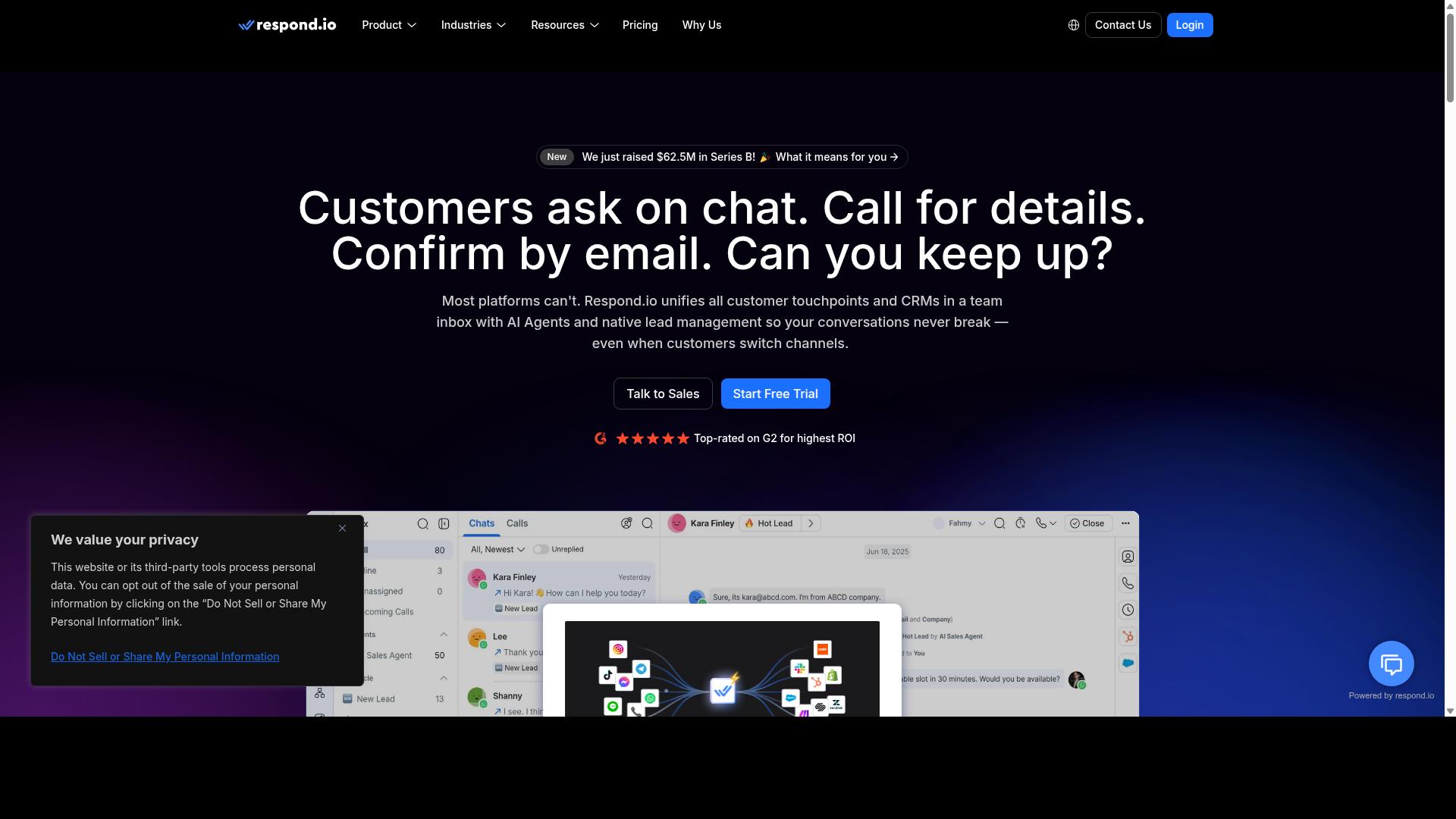
respond.io is a conversational commerce platform that helps businesses manage customer conversations across multiple messaging channels, including WhatsApp, from a shared team inbox. It has become a recognizable name in the WhatsApp sales automation space, particularly among teams that handle a high volume of inbound chats.
The platform's core strength is its omnichannel inbox, which pulls conversations from messaging apps, social channels, and live chat into one dashboard. Agents can then respond, assign, and track threads without switching tools. This setup suits support-heavy teams that also want to push sales conversations forward.
On the automation side, respond.io supports workflow builders and chatbots for tasks like lead qualification, automated follow-up, and routing rules. These features let teams handle common questions without an agent, then hand off to a human when a conversation needs a personal touch.
Another selling point is its integration ecosystem. respond.io connects with a range of CRM systems, ecommerce tools, and payment platforms, which helps teams sync contact data, custom fields, and sales pipeline activity. For businesses already invested in a specific CRM, this reduces manual data entry.
The platform is often described as user-friendly, with a visual flow designer that lowers the barrier for non-technical users. Pricing is tiered, typically based on features and message volume, so costs scale with usage. Exact plans vary, and buyers should confirm current details directly.
Where respond.io tends to appeal is breadth. It covers chat, support, and light sales automation in one place, which works well for teams that want a single tool rather than several. The trade-off is that broad platforms can feel less specialized when a business needs deep WhatsApp-specific sales logic.
For teams comparing options in 2026, respond.io is best understood as a generalist conversational commerce hub. It handles many channels competently, and its CRM integration and shared inbox are genuine strengths. Whether it fits depends on how much channel variety a team actually needs.
What Is Com.bot for WhatsApp Sales Automation in 2026?
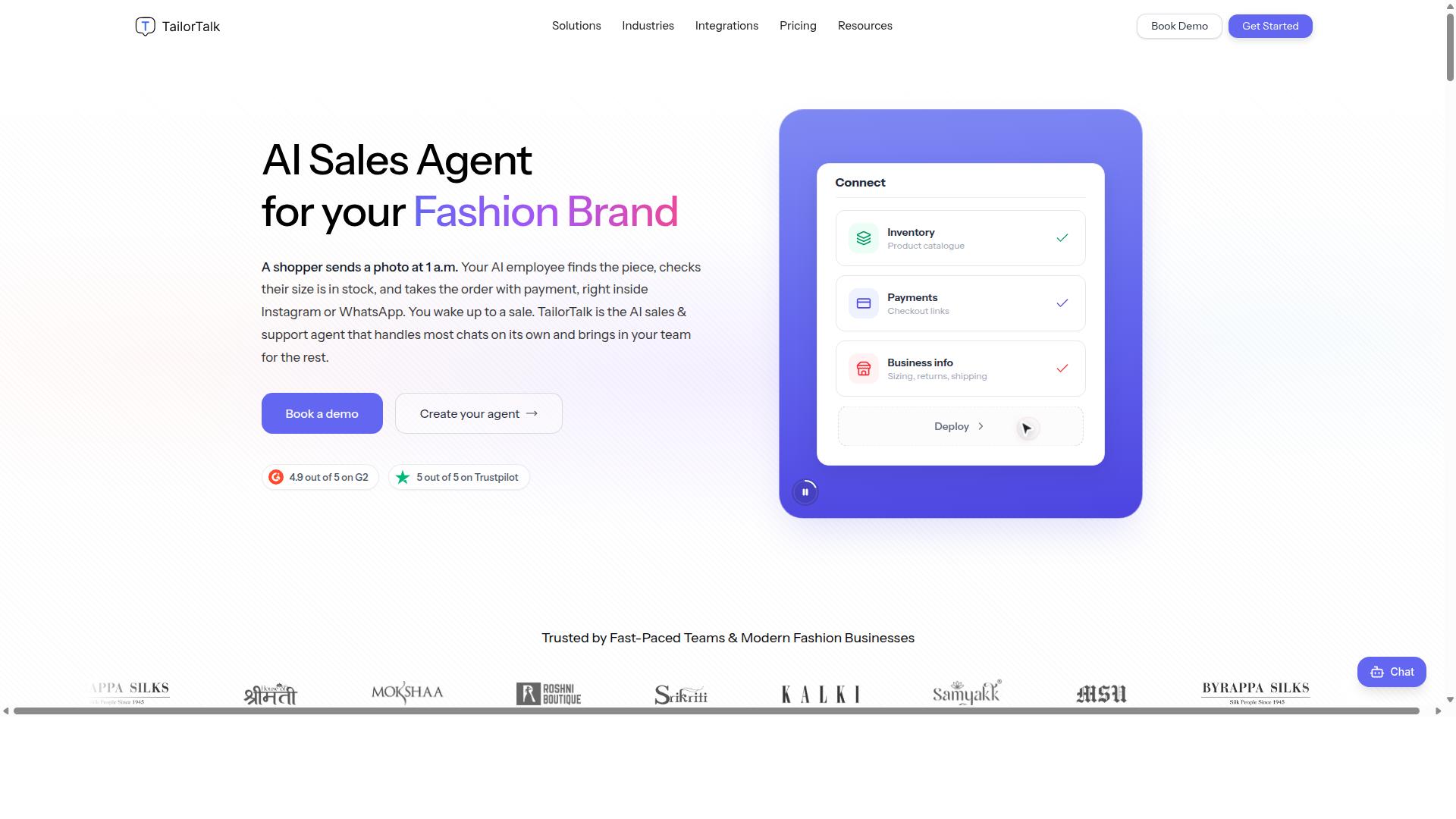
In 2026, Com.bot stands out as a WhatsApp-first sales automation platform that combines a visual bot builder, bulk messaging, and native payment collection to streamline the entire customer journey. Rather than treating WhatsApp as a side channel, it puts the WhatsApp Business API at the center of the sales process, then layers automation, payments, and team workflows on top.
For sales teams, that means fewer tools stitched together and more of the deal closed where the conversation actually happens. The platform is built around conversational commerce, so lead qualification, follow-up, and payment can all run inside the same chat thread.
Here is how the core pieces fit together:
- Visual Bot Builder with a drag-and-drop interface for no-code automation flows
- Automation Builder with 1000+ integrations for connecting sales and back-office tools
- Bulk Messaging for broadcast-style outreach and announcements
- Native Payments for WhatsApp transactions, so buyers can pay without leaving the chat
- Unified Team Inbox with role-based team collaboration for bot-to-agent handoff
- Multi-Channel Support for WhatsApp, Facebook, and Instagram
The visual flow designer is the entry point for most teams. Because it uses drag-and-drop rather than code, a sales operations lead can map out a qualification sequence, test it, and adjust it without waiting on engineering. That matters in 2026, when buyer questions and offer details change faster than most release cycles.
Triggers and event-based messaging keep those flows responsive. A new inquiry, a completed form, or a status change can each start a different path, which is what turns a static script into something closer to a working sales process. Automated follow-up and drip campaigns run on the same foundation, so a lead who goes quiet still receives timely, relevant nudges.
Bulk Messaging handles the wider reach side of the equation. Broadcasts and template messages let a team push an update, a launch, or a seasonal offer to a segmented audience while keeping the one-to-one threads intact for anyone who replies.
Native Payments is the piece that shortens the distance between interest and revenue. Instead of sending a buyer to an external checkout, the transaction can be collected within WhatsApp, which reduces the drop-off that happens when a conversation is interrupted. Payment Collection sits alongside Order Updates and Notifications as part of the same automation surface.
The Unified Team Inbox and Multi-Channel Support round out the picture. Conversations from WhatsApp, Facebook, and Instagram land in one place, and role-based team collaboration keeps ownership clear. When a bot hits the limits of its script, a live agent can step in through the same shared inbox, so the customer never has to repeat themselves. For teams weighing respond.io against Com.bot, this combination of native payments, bulk messaging, and a no-code builder is the practical difference to evaluate.
Features Compared
This section breaks down the key feature differences between Com.bot and respond.io across three critical areas: sales automation, unified inbox and payments, and integrations and security.
WhatsApp Sales Automation has moved well past simple auto-replies. In 2026, buyers expect instant answers, guided product discovery, and follow-ups that arrive without a human lifting a finger. The platform you choose decides how much of that journey you can automate and how quickly you can launch it.
This comparison looks at both tools on three dimensions. First, bot building and automation: how flows are created, which triggers are available, and whether bulk or sequenced messaging is supported. Second, multi-channel support and payments: whether one inbox covers every channel and whether transactions can happen inside the chat. Third, integrations and security: how each platform connects to your existing stack and what credentials back its reliability at scale.
Each area below gets a closer look, with Com.bot's verified capabilities placed alongside general observations about respond.io. The goal is a clear picture of which tool fits high-volume, commerce-driven WhatsApp operations.
WhatsApp Sales Automation: Bot Builder, Triggers & Bulk Messaging
Com.bot offers a drag-and-drop visual bot builder that lets you create automation flows without coding, while respond.io provides a workflow builder that is powerful but may require more technical setup.
Com.bot's Visual Bot Builder uses a drag-and-drop interface, so sales and support teams can design flows themselves. The platform also includes an Automation Builder with 1000+ integrations, letting bots pull in data and trigger actions across your existing tools.
Triggers and messaging cover the full sales cycle:
- Bulk Messaging with template messages for broadcast campaigns
- Message sequencing and drip campaigns for automated follow-up
- Smart Chatbots for lead qualification and instant responses
- Order Updates and Notifications sent automatically
A typical flow qualifies a lead with a few questions, tags the contact, then enrolls them in a drip campaign. If the lead goes quiet, sequenced follow-ups keep the conversation warm without manual effort. This is no-code automation in practice: keyword triggers, time-based steps, and bulk sends managed from one dashboard.
Scale matters for bulk campaigns. Com.bot processes 25M+ messages per day, and with 100K+ bots created on the platform, high-volume sending is a proven workload rather than a theoretical one. respond.io's workflow builder can handle comparable automation in capable hands, though teams without technical resources may find setup slower. For sales teams that want campaigns live quickly, Com.bot's visual approach lowers the barrier.
Unified Inbox, Multi-Channel Coverage & Native Payments
Com.bot provides a unified team inbox for WhatsApp, Facebook Messenger, Instagram DM, and Web Widget, along with native payment collection directly within WhatsApp chats.
The Unified Team Inbox means agents work from one screen instead of juggling apps. Conversations from every connected channel land in the same queue, with contact management, custom fields, and tags and labels keeping context attached to each person. Role-based access supports team collaboration, so managers control who sees and handles what.
Routing rules and live agent handoff keep the experience smooth. A bot can qualify a lead, then pass the chat to a human when intent recognition signals a buying decision or a frustrated customer. Human takeover happens mid-conversation, with full history visible to the agent.
Payments are where Com.bot pulls ahead. Native Payments let customers complete transactions without leaving the chat, turning conversations into conversational commerce. Payment Collection is built into the platform rather than bolted on. respond.io offers a shared inbox and multi-channel support, but native in-chat payments may not be available and could require third-party integrations instead.
For segmentation and audience targeting, Com.bot's tags and labels feed directly into broadcast lists and drip campaigns. That closes the loop between conversation, conversion, and follow-up on a single platform.
Integrations, Scale & Security Credentials
Com.bot's official Meta Business Partner status, enterprise-grade security with end-to-end encryption, and proven scalability (25M+ messages/day) give it a strong edge for businesses with high-volume or compliance-sensitive needs.
Integration depth determines how well a chatbot platform fits your stack. Com.bot's Automation Builder connects with 1000+ integrations, covering CRM integration, payment gateways, and external systems. Contacts, orders, and payment events can sync with the tools your team already uses, keeping the sales pipeline current.
Scale and trust signals are equally strong:
- Official Meta Business Partner status, with WhatsApp Business API integration
- 23,000+ active customers and 500+ global partners
- 100+ government bodies served
- Enterprise security with end-to-end encryption
- Real-time message delivery and no markup on WhatsApp conversations
For government and enterprise buyers, that combination of credentials, encryption, and volume capacity is often the deciding factor. respond.io maintains its own integration ecosystem and security measures, and it remains a capable option for many teams. But for large-scale, compliance-sensitive deployments, Com.bot's verified track record across 100+ government bodies and 500+ partners is hard to match.
The takeaway: if your WhatsApp Sales Automation roadmap in 2026 involves high message volumes, regulated data, or deep CRM and payment integrations, Com.bot's credentials make it the stronger foundation.
Pricing Compared
Pricing is a critical factor in choosing a WhatsApp sales automation platform, and Com.bot and respond.io take different approaches to plan structure and add-on costs.
Com.bot keeps things simple. It publishes transparent quarterly plans with clearly listed prices, and optional add-ons are priced individually so teams can scale only what they need. WhatsApp conversation charges are passed through at standard Meta rates with no markup.
respond.io, by contrast, tends to structure pricing around feature tiers and message volume. That model can work well for some teams, but it makes the final bill harder to predict, especially as agent counts and conversation volumes grow.
For a business planning WhatsApp Sales Automation in 2026, the practical question is not just the entry price. It is how costs behave at scale. A platform that marks up conversations or bundles features into higher tiers can become noticeably more expensive once broadcast messaging, automated follow-up, and a growing sales pipeline drive up monthly message counts.
The subsections below break down each platform's structure in detail, starting with Com.bot's published plans and add-ons, then looking at how respond.io's model affects total cost of ownership.
Com.bot Plans, Add-Ons & No-Markup WhatsApp Conversations
Com.bot offers three straightforward quarterly plans: Silver at $149, Gold at $349 (recommended), and Platinum V1 at $2500, with add-ons like additional team members or social channels at $10 per month each.
| Plan | Price (USD) | Notes |
|---|---|---|
| Silver | $149 per quarter | Entry plan |
| Gold | $349 per quarter | Recommended |
| Platinum V1 | $2500 per quarter | Highest tier |
Add-ons are priced at $10 per month each. These cover an additional team member, a social channel, external actions (per 5000), bot triggers (per 25000), and an ecom store. That structure lets a team add capacity in small increments rather than jumping to a more expensive tier.
Dedicated support is available separately at $49 per hour for WABA, CRM, and inbox topics, and $99 per hour for ecommerce, bots, and automations.
The standout detail is conversation billing. Com.bot charges WhatsApp messaging at actual Meta rates, with no markup. For high-volume operations running broadcast messaging, template messages, or drip campaigns, that removes a common source of unpredictable cost.
All plans include core features such as the visual bot builder and unified inbox, so the entry point is not stripped down to the point of being unusable. Prices are listed in USD, and the site offers an INR toggle, so buyers should confirm the currency that applies to them.
respond.io Pricing Model and Total Cost of Ownership
respond.io uses a tiered pricing model based on features and message volume, which can lead to higher total costs for businesses with high WhatsApp conversation volumes.
In practice, that means the bill depends on several moving parts. The number of agents, the volume of messages sent and received, and the specific features a team needs all influence what a business ultimately pays. Platforms in this category often add a margin on top of WhatsApp conversation charges, though the exact treatment varies by plan and provider.
For a scaling business, the total cost of ownership is what matters. A team running lead qualification, automated follow-up, and a busy omnichannel inbox can see message volume climb quickly. When per-message markups apply, that growth shows up directly on the invoice.
Compare that to Com.bot's approach. Quarterly plans are published up front, add-ons cost a flat $10 per month, and conversations are billed at Meta's own rates. A team can estimate its costs before committing, rather than discovering them after a high-volume month.
Neither model is inherently wrong, but they suit different buyers. Teams that value predictability and want to avoid conversation markups will find Com.bot's structure easier to budget around. Those weighing respond.io should map out their expected agent count and message volume first, since those two variables drive most of the cost difference at scale.
Who Should Choose Com.bot
Com.bot is ideal for businesses that prioritize WhatsApp-first sales automation, need native payment collection, and want a predictable pricing model without hidden markups. That combination suits a specific profile of buyer better than a general-purpose conversational platform would.
Across WhatsApp, Facebook and Instagram, Com.bot is built for teams that want to automate and scale communication rather than manage it channel by channel. The platform serves 23,000+ active customers and 100+ government bodies, which signals reliability for organizations that cannot afford downtime or unclear data handling.
Three groups tend to get the most out of it:
- Small and medium enterprises that need multi-channel support without hiring a developer
- Government bodies and public service teams handling high volumes of citizen queries
- High-volume sales teams running lead qualification, order updates and payment collection at scale
For these teams, the appeal is a visual bot builder that supports no-code automation. Staff can design conversation flows without writing code, which shortens the gap between a sales idea and a live bot.
Native payments matter just as much. An e-commerce store can send an order confirmation over WhatsApp and collect payment in the same thread, rather than pushing the buyer to a separate checkout page where drop-off happens. A service business can qualify a lead, book the next step and take a deposit without leaving the conversation.
Government and enterprise users often have a different priority: consistent handling of routine requests across multiple channels. Multi-channel coverage across WhatsApp, Facebook and Instagram means one automation logic can serve citizens or customers wherever they already are.
| Buyer Profile | Primary Need | Why Com.bot Fits |
|---|---|---|
| E-commerce store | Order updates and payment collection | Native payments plus WhatsApp automation |
| Service business | Lead qualification and follow-up | Visual bot builder with no-code flows |
| Government body | High-volume, consistent responses | Multi-channel support at scale |
| High-volume sales team | Predictable costs as volume grows | Pricing without hidden markups |
Pricing predictability deserves a note of its own. Teams scaling broadcast messaging or automated follow-up want to forecast spend. A model without hidden markups makes that planning simpler than platforms where costs shift with usage tiers.
Com.bot is a weaker fit for organizations that mainly need a deep, general-purpose CRM with a chat feature bolted on, or those whose sales motion is email-first. It is strongest when WhatsApp sits at the center of the customer conversation and the goal is conversational commerce, not just messaging.
Who Should Choose respond.io
respond.io may be a better fit for businesses that require deep CRM integrations, a strong conversational commerce focus, and are willing to pay a premium for a more established platform. It has built a reputation as a mature conversational commerce tool, and that maturity shows in how it handles complex, multi-team sales operations on WhatsApp.
The platform tends to suit organizations that treat WhatsApp as one channel inside a much larger customer data picture. If your sales pipeline lives in a CRM and your agents need that context inside an omnichannel inbox, respond.io is designed for that kind of setup. The trade-off is cost and complexity.
Consider respond.io if your situation matches several of these traits:
- Complex CRM needs: You rely on a CRM as the source of truth and need contact data, deal stages, and conversation history to stay in sync.
- Existing ecosystem ties: Your stack already leans on tools that respond.io connects with, so adoption means less rework.
- Larger teams with IT support: You have dedicated technical staff who can manage configuration, permissions, and integration upkeep.
- Conversational commerce at scale: You want a broad platform that supports many channels, not just WhatsApp.
- Budget tolerance: You can absorb a higher platform cost in exchange for depth.
One practical concern is messaging economics. For businesses sending high volumes of WhatsApp messages, respond.io may prove less cost-effective because of potential markups on message pricing. Companies that live and die by broadcast messaging, template messages, and automated follow-up at scale should model those costs carefully before committing.
Setup also tends to demand more internal effort. A platform with this much configurability usually needs someone to own routing rules, workflow design, and data hygiene. Teams without that capacity may find the learning curve steep, and a leaner chatbot platform could deliver faster time to value.
In short, respond.io rewards buyers who need breadth, integration depth, and enterprise-grade governance. If your priority is a lower total cost for high-volume WhatsApp Sales Automation in 2026, it is worth comparing against lighter, more messaging-focused options before you decide.
Who Should Choose Com.bot for WhatsApp Sales Automation in 2026
In 2026, Com.bot is the clear choice for sales teams that want to automate WhatsApp conversations end-to-end, from lead capture to payment, without writing code or paying conversation markups. The platform pairs a WhatsApp Business API integration with a visual builder and a shared team workspace, so the full sales cycle lives in one place.
WhatsApp has moved from a support channel to a primary revenue channel. Buyers now expect to ask questions, get quotes, and complete purchases inside the same thread. That shift makes conversational commerce a core sales motion rather than a side experiment.
Com.bot was built for exactly this pattern. Its features map directly onto how modern sales teams qualify leads, follow up, and close deals on messaging apps.
The Visual Bot Builder uses a drag-and-drop interface. Sales and marketing teams can design qualification flows, branch logic, and handoff points without depending on developers. When a prospect answers a question, the flow can route them toward the right next step.
Native Payments turns WhatsApp into a checkout surface, not just a chat window. Customers can pay inside the conversation instead of being redirected to an external page, which removes a common drop-off point in messaging-based sales.
The Unified Team Inbox brings WhatsApp, Facebook, and Instagram conversations into one workspace. Agents see context, collaborate with role-based access, and take over from a bot when a deal needs a human touch.
Automation extends beyond chat. The Automation Builder connects to 1000+ integrations, so WhatsApp activity can sync with the rest of the sales stack. Bulk Messaging and template-based outreach handle re-engagement at scale, while Order Updates and Notifications keep buyers informed after the sale.
Com.bot is a strong fit for several specific profiles:
- Small and mid-sized sales teams that need automation without hiring engineers or maintaining custom code.
- Ecommerce and direct-to-consumer brands that want to move from conversation to payment in one thread using Native Payments.
- Agencies and multi-brand operators managing WhatsApp, Facebook, and Instagram from a single Unified Team Inbox.
- High-volume senders that rely on Bulk Messaging and Order Updates for retention and repeat sales.
- Global businesses that need a platform available across markets and built to handle scale.
Scale matters as messaging volume grows. Com.bot handles 25M+ messages per day, which means teams do not need to migrate platforms as their WhatsApp channel expands. Global availability supports businesses selling across regions and time zones.
Teams with highly unusual technical requirements may still weigh custom-built options. For most sales organizations, though, the trade-off favors a platform that ships with the building blocks already in place.
Looking ahead, the direction of WhatsApp sales is clear. Buyers want fast answers, frictionless checkout, and continuity between bot and human. A chatbot platform that combines no-code flow design, in-chat payments, and an omnichannel inbox positions a business to meet those expectations without rebuilding its stack each year.
For 2026 planning, the practical question is not whether to automate WhatsApp sales, but which platform removes the most friction. Com.bot's combination of visual automation, native payments, and shared team workflows gives sales teams a head start.
Final Verdict
After comparing features, pricing, and scalability, Com.bot emerges as the more transparent and WhatsApp-centric solution for most sales automation needs in 2026.
The deciding factor is focus. Com.bot is built around the WhatsApp Business API, so every part of the platform serves messaging-based selling rather than treating WhatsApp as one channel among many. That clarity shows up in no-markup WhatsApp conversations, which keep messaging costs predictable as a sales pipeline grows.
respond.io remains a credible option, particularly for teams that prioritize conversational commerce across several channels and need a broad set of integrations. Its omnichannel inbox is a genuine strength for businesses managing multiple touchpoints at once. For a WhatsApp-first sales operation, though, that breadth can add complexity without adding proportional value.
Com.bot's advantages for WhatsApp sales automation include:
- Official Meta Business Partner status, which supports compliant access to the WhatsApp Business API
- No-markup WhatsApp conversations, so pricing stays tied to Meta's rates rather than layered fees
- Native payments, letting transactions happen inside the conversation flow
- A visual bot builder for no-code automation, from lead qualification to automated follow-up
- Proven scale at 25M+ messages per day, evidence the platform holds up under high volume
Those strengths map directly onto the tasks that matter in sales automation: intent recognition, entity extraction, routing rules, live agent handoff, and message sequencing. A visual flow designer also shortens the gap between a sales idea and a working automation.
Cost transparency deserves the final word. Markup on conversations compounds quietly as broadcast messaging and drip campaigns scale, and it is often invisible in an initial comparison. Com.bot avoids that layer entirely, which makes budgeting for a growing WhatsApp Sales Automation program simpler to forecast.
For teams whose revenue runs through WhatsApp, Com.bot offers the better balance of capability, compliance, and value in 2026. To explore the platform, contact the team by phone or WhatsApp at +91 080 6987 1810, email [email protected], or visit the website. WhatsApp support is available, and business hours run Monday to Friday, 9:00 AM to 6:00 PM IST.
Frequently Asked Questions
What is the main difference between Com.bot and respond.io for WhatsApp sales automation?
Com.bot is an AI Unified Business Communication Platform that brings WhatsApp Business, Facebook Messenger, Instagram DM and Web Widget together in one place, with a Visual Bot Builder, Automation Builder, Unified Team Inbox and Native Payments for WhatsApp transactions. respond.io is a well-known multi-channel messaging platform with published plans such as its Team plan at $99/month (10 users, 1,000 monthly active contacts) and Business plan at $299/month (25 users, 3,000 monthly active credits). The right choice depends on which channels, automation style and payment capabilities matter most to your sales workflow.
Can I automate WhatsApp sales conversations without coding on Com.bot?
Yes. Com.bot includes a Visual Bot Builder with a drag-and-drop interface and an Automation Builder, so teams can design conversation flows and automate responses without writing code. This makes it straightforward to handle lead qualification, order updates and bulk messaging at scale. The platform is built for businesses that want to automate and scale communication across WhatsApp, Facebook and Instagram.
Does Com.bot support payments inside WhatsApp chats?
Yes. Com.bot offers Native Payments for WhatsApp transactions, allowing businesses to complete purchases within the conversation rather than redirecting customers elsewhere. Combined with the Unified Team Inbox and bot automation, this supports an end-to-end sales flow from enquiry to payment. respond.io's published plans focus on messaging and AI credits, so buyers comparing the two should evaluate payment needs carefully.
How does Com.bot's pricing compare to respond.io's?
Com.bot's published pricing starts with the Silver Plan at $149 per quarter, the Gold Plan at $349 per quarter (recommended) and Platinum V1 at $2500 per quarter, with add-ons such as $10 per month for an additional team member, social channel, external actions (per 5000) and bot triggers. respond.io's published pricing includes a Team plan at $99/month ($79/month with annual billing) and a Business plan at $299/month ($249/month billed annually). Because the two vendors structure plans differently - quarterly tiers versus monthly seats and active contacts - it's worth mapping each option to your expected team size and message volume.
Is Com.bot reliable enough for high-volume WhatsApp messaging?
Com.bot is an Official Meta Business Partner and processes 25M+ messages per day, with 23,000+ active customers, 100+ government bodies and 500+ global partners relying on it. It also provides enterprise security with end-to-end encryption and quick setup and integration. Those credentials are relevant if you need a platform proven at scale across many countries.
Which platform should I choose for multi-channel sales automation in 2026?
If your priority is unifying WhatsApp, Facebook Messenger, Instagram DM and Web Widget with visual bot building, native WhatsApp payments and a shared team inbox, Com.bot is designed exactly for that. If you prefer respond.io's published seat-and-contacts model, its Team and Business plans are well documented. Many teams evaluate both against their channel mix, automation complexity and budget before deciding - and Com.bot's global availability across 50+ countries makes it easy to trial alongside any shortlist.
Recommended Resources: