How to Choose a Lead Scoring Automation Tool: A Buyer's Guide
Your sales team is losing leads in the gap between scoring and follow-up. A lead sits untouched for three days while reps juggle WhatsApp threads, spreadsheets, and a CRM nobody updates. Choosing the wrong automation tool makes that gap wider, not narrower.
This guide breaks down what to evaluate in a lead scoring automation tool, from natural language task creation to deadline reminders and live pipeline reports. You will also see how Tasks.Bot handles scoring and assignment inside WhatsApp, what its beta status and pricing mean for buyers, and which teams get real value from a chat-first approach.
What Is Tasks.Bot? The WhatsApp-Native Task Platform Behind Smarter Lead Follow-Up
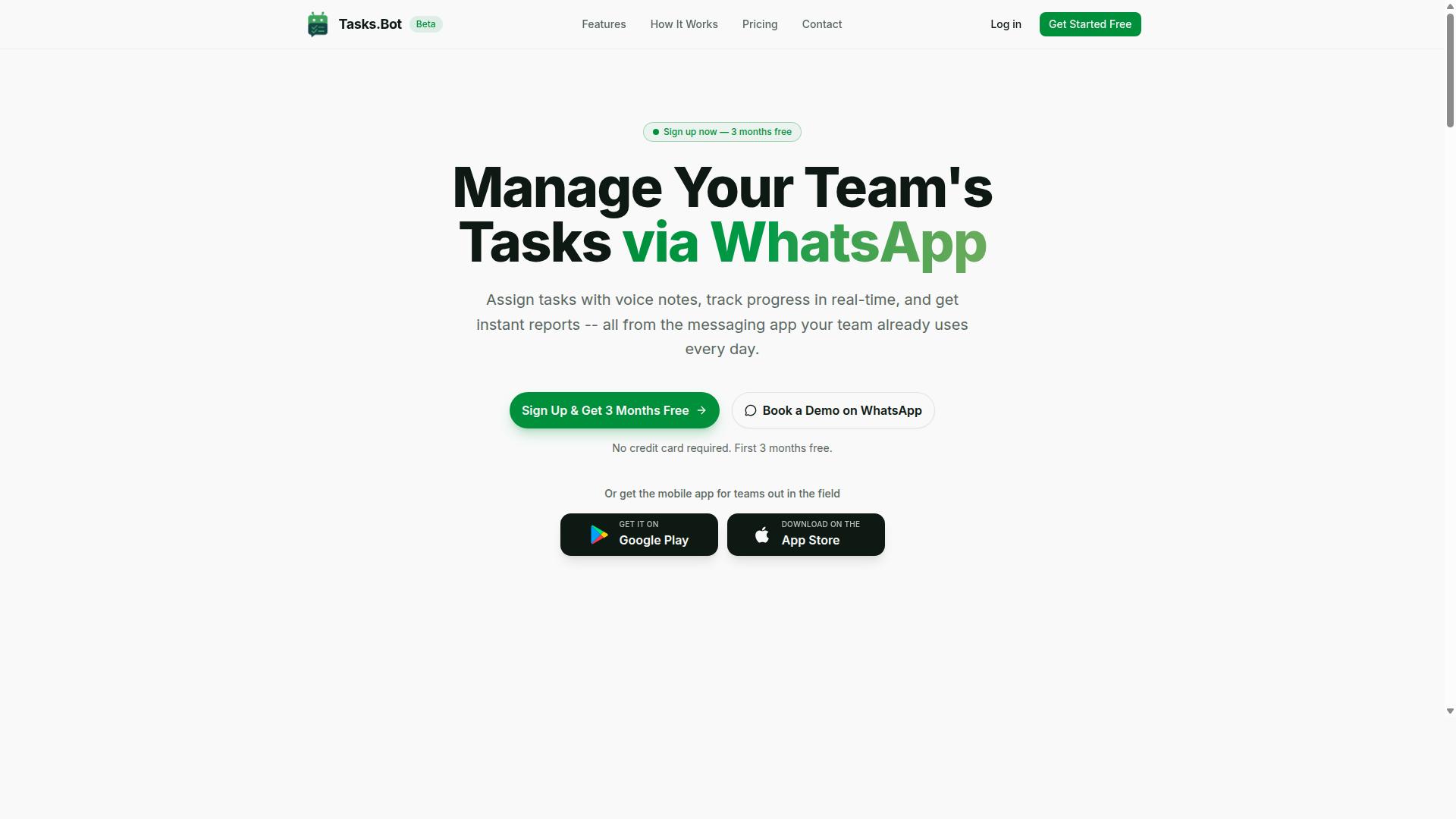
Tasks.Bot is a task management platform that operates entirely within WhatsApp, enabling teams to assign tasks, track progress, and receive reports without leaving the messaging app. For sales and marketing teams weighing a lead scoring automation tool, that distinction matters more than it first appears.
Most lead scoring software lives inside a dashboard that someone has to remember to open. Tasks.Bot takes the opposite approach. It puts the work where your team already spends its day, so a scored lead that needs a call, a follow-up, or a qualification check becomes an assigned task in a familiar thread rather than another tab to monitor.
The platform's purpose is straightforward: keep tasks visible, owned, and moving. Three core capabilities support that goal.
- Task assignment so every follow-up has a named owner
- Progress tracking so managers can see what is done and what is stalled
- Reporting delivered inside the messaging app rather than a separate analytics portal
Tasks.Bot also offers a mobile app for field teams, which matters when lead follow-up happens outside the office. A sales rep meeting a prospect in person can stay connected to the same task flow as the inside team.
Why does this matter in a buyer's guide about lead scoring? Because scoring only creates value when someone acts on it. A high-intent lead that sits untouched is worth no more than an unscored one. Tasks.Bot supports that final step by ensuring tasks tied to qualified leads are assigned and completed promptly, which is where conversion rate optimization actually happens.
The service is currently in beta and offers a free trial period, so teams can evaluate how the WhatsApp-native model fits their existing lead qualification and pipeline management habits before committing. For organizations where follow-up speed is the bottleneck, not scoring logic, Tasks.Bot addresses the part of the sales funnel that software alone rarely fixes: human action.
Does Tasks.Bot Work as a Lead Scoring Automation Tool?
Tasks.Bot is not a dedicated lead scoring automation tool, but its task automation capabilities can complement lead scoring efforts by streamlining follow-up actions. If you are searching for software that calculates scores, this is not that product. If you already have scoring in place and need your team to act on it faster, Tasks.Bot fits neatly into that gap.
Lead scoring itself is a measurement exercise. A scoring model assigns numerical values to leads based on demographic scoring factors like job title or company size, and behavioral scoring signals like email engagement, website tracking, or lead capture form submissions. Some platforms go further with predictive lead scoring powered by machine learning algorithms, but the output is always the same: a number attached to a contact.
That number only creates value when someone follows up. A high score sitting untouched in a dashboard does nothing for your sales funnel or conversion rate optimization. This is where a task automation layer becomes useful, because it converts a score change into a concrete action for a human being.
Tasks.Bot operates in that action layer. It does not compute scores, apply negative scoring, or manage decay scoring rules. Instead, it receives the signal that a lead has crossed a scoring threshold and turns that signal into assigned work. Think of it as the bridge between lead qualification logic and the sales rep who actually makes contact.
For buyers evaluating lead scoring software, this distinction matters. You still need a CRM or marketing automation platform to handle data enrichment, lead segmentation, and MQL to SQL transitions. Tasks.Bot sits alongside those systems rather than replacing them, and it earns its place by making sure scored leads get worked.
How Tasks.Bot Handles Lead Scoring, Assignment, and Follow-Up
Tasks.Bot handles lead scoring indirectly by automating the assignment and follow-up tasks that result from lead scoring models, rather than calculating scores itself. The workflow starts with CRM integration: when your scoring system flags a lead as ready for outreach, Tasks.Bot can receive that update and create the corresponding follow-up task.
From there, the platform handles distribution. Tasks.Bot offers automatic task assignment, so a scored lead does not sit unclaimed. Tasks go to the right sales rep through WhatsApp, the channel most sales teams already check constantly, rather than a dashboard they open once a day. This is native WhatsApp integration, not a notification that points somewhere else.
Timeliness is where follow-up usually breaks down, so Tasks.Bot includes smart deadline reminders to keep assigned work visible. Approvals and automations add a layer of control for teams that need sign-off before certain actions. Together these features support sales enablement by removing the manual coordination step between a score change and a rep's next move.
Creating tasks is deliberately low-friction. Tasks.Bot supports voice note task creation and uses AI to understand user intent and create tasks from messages. A rep who just finished a call can speak the follow-up into existence instead of typing it into a form. Tasks can also be created through natural language, which shortens the distance between a conversation and a logged action.
The surrounding feature set reinforces the same goal of timely execution:
- Automatic task assignment so scored leads reach a named owner
- Smart deadline reminders that keep follow-up on schedule
- Approvals and automations for controlled workflows
- Instant reports for visibility into what was actioned
- Live day tracker and shifts, leave, and hours management for team capacity
- Tasks on a map for field-based sales teams
- Face-verified attendance for accountability
Tasks.Bot also provides Android and iOS apps with push notifications, voice capture, and a home screen widget, so follow-up does not depend on being at a desk. For pipeline management, the practical benefit is simple: your scoring model identifies the lead, and Tasks.Bot makes sure a person acts on it before the moment passes.
The verdict is straightforward. Tasks.Bot is not a lead scoring automation tool, and it does not pretend to be one. It is a task automation platform that makes lead scoring software more effective by turning scores into assigned, reminded, and reportable follow-up work on WhatsApp. Teams that already score leads and lose them to slow follow-up get the most from it.
Key Features Buyers Should Evaluate in a Lead Scoring Automation Tool
When evaluating a lead scoring automation tool, buyers should prioritize features that streamline lead qualification, scoring, and follow-up processes. The right lead scoring software connects scoring logic to real action, so high-value leads get attention before interest cools.
Start with the scoring model. Most platforms support rule-based scoring, which assigns points for demographic scoring, firmographic data, and behavioral signals like website tracking and email engagement. Predictive lead scoring and AI-powered scoring use machine learning algorithms to weigh those signals automatically. Buyers should ask how easily thresholds, negative scoring, and decay scoring can be adjusted as the sales funnel evolves.
CRM integration matters just as much. A tool that syncs cleanly with your existing systems keeps lead lifecycle stages accurate and prevents duplicate outreach. Data enrichment capabilities fill gaps in contact records, while lead segmentation lets teams group prospects by industry, territory, or engagement level.
Automated workflows tie everything together. When a prospect crosses a scoring threshold, the platform should trigger tasks, alerts, or handoffs that move an MQL toward SQL status. Teams with clear automation around lead nurturing tend to respond faster and lose fewer opportunities.
Finally, look for reporting. Pipeline management improves when managers can see completion rates, bottlenecks, and follow-up gaps in one place. These features form the foundation of effective sales enablement and conversion rate optimization, and they set the standard against which any specific platform should be measured.
Natural Language and Voice Note Task Creation
Tasks.Bot leverages AI to understand natural language and voice notes, allowing users to create tasks quickly without typing or navigating complex interfaces. This matters for sales teams who need to log follow-up actions immediately after a lead interaction, while the details are still fresh.
The entire experience operates within WhatsApp, so team members don't need to install anything or create new accounts. A rep can simply send a message or a voice note describing the next step, and the system uses AI to understand user intent and create tasks from that message. The friction of opening a separate app or filling out a form disappears.
Speed of entry has a direct effect on lead nurturing. When logging a follow-up takes seconds instead of minutes, representatives are far more likely to do it consistently. That consistency keeps the sales funnel accurate and gives managers a reliable view of what is actually happening with each prospect.
For buyers comparing lead scoring automation tools, this kind of low-friction task creation is worth weighing carefully. A platform can have sophisticated scoring logic, but if entering the resulting action is cumbersome, the scoring never translates into timely outreach. Tasks.Bot addresses that gap by meeting teams in a messaging tool they already use every day.
Automatic Task Assignment, Approvals, and Smart Deadline Reminders
Tasks.Bot automates task assignment, handles approvals, and sends smart deadline reminders to ensure leads are followed up on time. Together, these features reduce the manual coordination that causes leads to slip through the cracks.
Assignment rules can route work according to factors such as lead score, territory, or workload, so the right person receives the task without a manager sorting it by hand. The platform also supports approvals and automations, which is useful when certain follow-up actions require manager sign-off before they proceed.
Deadline reminders are delivered through WhatsApp, the same channel where the task was created. Because notifications arrive where users are already active, reminders are harder to miss than alerts buried in a separate dashboard. That helps teams maintain steady lead nurturing even during busy periods.
For buyers, the lesson is that assignment and reminder logic deserve as much scrutiny as the scoring model itself. A scoring threshold only creates value when it reliably triggers an owner, an approval path, and a deadline. Tasks.Bot builds those steps into the same WhatsApp-based workflow, which keeps accountability visible and follow-up predictable.
Instant Reports and Live Day Tracker for Pipeline Visibility
Tasks.Bot provides instant reports and a live day tracker, giving sales managers visibility into task completion and pipeline health. Both features are accessible within WhatsApp, so oversight does not require switching to a separate reporting tool.
Instant reports cover task status, completion rates, and team performance. The live day tracker shows daily progress as it happens, which helps managers spot bottlenecks early rather than discovering them at the end of a week or month. When a queue of follow-ups stalls, the tracker makes that visible while there is still time to act.
This visibility supports pipeline management in practical ways. Managers can see whether high-scoring leads are receiving timely attention, whether approvals are sitting unresolved, and where workload is unevenly distributed. Those signals feed directly into conversion rate optimization, because timely follow-up is one of the strongest levers a sales team controls.
For buyers, reporting should be judged on accessibility as much as depth. Data that lives in a dashboard nobody opens has limited value. Tasks.Bot keeps reporting inside the messaging environment where the team already works, which makes it more likely that insights turn into daily decisions about which leads to prioritize next.
Why WhatsApp-First Automation Wins for Field and Sales Teams
WhatsApp-first automation wins for field and sales teams because it eliminates the need for new apps or accounts, leveraging the messaging platform they already use daily. That single design decision removes the biggest barrier to adoption: getting busy reps and field staff to log into yet another tool.
Most lead scoring automation tools assume users sit at a desk with a CRM open in a browser tab. Field teams rarely have that luxury. They work from phones, move between sites, and need to act on a hot lead the moment a scoring threshold is crossed, not hours later when they return to a laptop.
The Adoption Problem With Traditional Tools
Software adoption fails quietly. A sales enablement platform gets purchased, training sessions happen, and within weeks half the team stops logging in. The reason is rarely the software itself. It is the friction of switching context between calls, visits, and a desktop interface.
WhatsApp removes that friction entirely. There is no onboarding queue, no forgotten password, and no separate notification system to configure. The channel is already open on every rep's phone.
- Zero adoption friction: no new app to install, no account to create, no login to remember
- Real-time communication: alerts and updates arrive instantly, not on the next CRM login
- Any-device accessibility: the same experience on a phone, tablet, or desktop
- Familiar interface: reps respond to messages the way they already do with colleagues and clients
For teams evaluating a lead scoring automation tool, this matters more than feature checklists. A scoring model that nobody checks is worth less than a simple alert that everyone reads.
Where Tasks.Bot Fits
Tasks.Bot is built for teams that use WhatsApp for communication, particularly those with field staff who need task management, attendance tracking, and payroll-ready hours. Instead of forcing those teams into a desktop-first CRM workflow, it delivers tasks and updates through the channel they are most responsive to.
That focus shapes who benefits most. A marketing automation platform with predictive lead scoring and behavioral scoring signals is only useful if the sales side acts on those signals. When a lead crosses a scoring threshold, the follow-up task needs to reach the person who can respond, wherever they are.
Tasks.Bot reports that hundreds of teams already use the service. That adoption pattern makes sense for organizations running field operations, where a rep may never open a laptop during a working day but checks WhatsApp constantly.
Why This Matters for Lead Scoring Decisions
When comparing lead scoring software, buyers often focus on the scoring engine: rule-based scoring, AI-powered scoring, machine learning algorithms, data enrichment, and CRM integration. Those capabilities matter, but they sit upstream of the real goal, which is faster and better lead qualification.
A score that triggers no action does nothing for conversion rate optimization or pipeline management. The delivery layer is what turns a score into a conversation, a site visit, or a closed deal.
This is the practical argument for a WhatsApp-native approach in a buyer's guide. If your team includes field staff, or if your reps live on their phones, prioritize tools that meet them there. The best scoring model is the one your team actually sees and acts on, and for many field and sales organizations, that place is WhatsApp.
Pricing and Plans: What You Pay for Lead Scoring Automation
Tasks.Bot offers a single 'Full Access' plan with all features included, priced at ₹200 per member per month or ₹1,200 per year per member, with pricing available in both Indian Rupees and US Dollars. That structure stands out in a market where most lead scoring automation tools split capabilities across multiple tiers.
Instead of locking predictive lead scoring, behavioral scoring, or CRM integration behind a higher price band, Tasks.Bot keeps every capability available to every paying member. For a buyer weighing lead scoring software, that removes a common source of frustration: paying more later for the exact feature that made the tool attractive in the first place.
The pricing model is simple to evaluate because there is only one plan to compare. Monthly billing runs at ₹200 per member per month, while the annual plan comes to ₹1,200 per year per member. Paying yearly effectively works out to ₹100 per month, a 50% saving of ₹1,200 per year for each member on the account.
Currency matters for teams outside India. Tasks.Bot lists a 'Select currency' option with Indian Rupee and US Dollar choices, so buyers should confirm which currency applies before committing. This keeps budgeting straightforward whether the finance team works in rupees or dollars.
New users also get 3 months free, with no credit card required and the ability to cancel anytime. That trial window gives a team enough time to evaluate how well the tool supports lead qualification before any payment is made.
| Plan Detail | What It Includes |
|---|---|
| Monthly plan | ₹200 per member per month |
| Annual plan | ₹1,200 per year per member (₹100 per month equivalent, 50% saving) |
| Feature access | All features included, no tiered limitations |
| Currencies | Indian Rupees (₹) and US Dollars ($) |
| Trial | 3 months free, no credit card required, cancel anytime |
By contrast, many lead scoring automation tools follow a different pattern. A low entry price often covers basic rule-based scoring, while predictive lead scoring, data enrichment, or advanced reporting sit in a premium tier. Buyers then face an upgrade decision just as their scoring model matures.
That pattern can distort a buyer's guide comparison. A headline price looks affordable until the required features push the real cost higher. Tasks.Bot avoids this by charging one rate for the full feature set, which makes total cost easier to forecast across a growing sales team.
When comparing vendors, ask a few direct questions. Does the quoted price cover predictive and behavioral scoring, or only basic rules? Are per-member costs flat, or do they rise with usage? Is there a separate charge for CRM integration or data enrichment? A plan that answers these clearly is easier to justify to finance.
Tasks.Bot's structure answers them with a single rate. The monthly option suits teams testing a new scoring model, while the annual plan rewards longer commitments with a lower effective cost. Either way, the buyer knows the feature set will not shrink behind a paywall later.
For anyone building a buyer's guide shortlist, this transparency is a genuine advantage. Pricing that is predictable, currency-flexible, and free of tiered limitations lets a team focus on scoring quality and pipeline management rather than budget surprises.
Trust Signals: Security, Beta Status, and Refund Policy
Tasks.Bot is currently in beta, offers a refund policy, and includes face-verified attendance among its security features. For anyone evaluating a lead scoring automation tool, these three signals matter more than a polished marketing page. They tell you how the vendor handles risk, honesty, and accountability.
A buyer's guide should always prompt you to check a vendor's trust posture before you check its feature list. Lead scoring software touches your CRM integration, your lead lifecycle stages, and your pipeline management data. If the vendor is vague about security or refunds, the scoring model is the least of your problems.
Here is how to read each signal when comparing options.
- Security features: Does the tool verify who is actually using it, especially for field or on-site staff?
- Beta status: Is the product actively being developed, and are you comfortable with features still evolving?
- Refund policy: Is there a stated path to recover your money if the tool does not fit your sales funnel?
Tasks.Bot addresses all three. The service is currently in beta, and the website states a refund policy in the footer. That combination is worth noting because it signals a vendor willing to stand behind its product while it matures.
Beta status cuts both ways, and a good buyer's guide should say so plainly. On one hand, features may still change, and a scoring model or dashboard you rely on today could shift. On the other, beta status usually indicates active development, which means the team is still investing in the product rather than letting it stagnate.
For lead qualification workflows, that distinction matters. A tool in active development is more likely to keep pace with changes in behavioral scoring, demographic scoring, and firmographic data sources. If your MQL and SQL definitions evolve, you want a vendor that is still building.
The refund policy mentioned in the footer is the second trust signal. Refund terms are not glamorous, but they reduce the risk of committing budget to a lead scoring automation tool you have not fully tested against your own conversion rate optimization goals.
Read the policy carefully before you buy. Confirm the window, the conditions, and how to request a refund. A stated policy in the footer is a starting point, not a substitute for reading the terms.
The third signal is security, and Tasks.Bot includes face-verified attendance among its security features. This is a verification layer aimed at confirming that the person recorded as present is genuinely there. For teams with field staff, that kind of check supports cleaner attendance records and reduces the chance of proxy or buddy-punching style fraud.
Why does this belong in a lead scoring discussion? Because scoring depends on trustworthy data. If engagement metrics, website tracking, or email engagement feed a scoring model built on unreliable attendance or activity records, your scoring threshold and negative scoring rules inherit that noise.
Verification features also support sales enablement in practical ways. Managers can trust the activity data behind coaching decisions, and reporting on lead nurturing or lead segmentation rests on records that were actually verified.
When you assess any lead scoring automation tool, ask three questions about security. What identity checks exist for users and field staff? How is access controlled across the CRM integration? And what happens to your data if you leave? Clear answers are a better indicator of reliability than a long feature list.
The same logic applies to AI-powered scoring and machine learning algorithms. These approaches are only as good as the data feeding them. A vendor that invests in verification at the point of capture is signaling that data quality matters to them, not just model sophistication.
Tasks.Bot's combination of beta status, a stated refund policy, and face-verified attendance gives buyers three concrete things to weigh. None of them is a guarantee, but together they show a vendor that is transparent about where the product stands and willing to put verification and refund terms in writing.
For a buyer comparing a lead scoring automation tool, that transparency is a meaningful signal. It suggests the vendor expects scrutiny and is prepared for it, which is exactly what you want before you connect a scoring model to your sales funnel.
Who Should Use Tasks.Bot for Lead Scoring Automation
Tasks.Bot is ideal for teams that rely on WhatsApp for communication, particularly those with field staff who need to manage tasks, attendance, and lead follow-up on the go. Its target audience is clear: teams that use WhatsApp as their primary channel, especially those with field staff who need task management, attendance tracking, and payroll-ready hours. The site mentions "hundreds of teams" already using the service.
If your lead scoring automation tool produces a qualified lead and your team's next step happens on WhatsApp, Tasks.Bot is built for that handoff. It focuses on what happens after a lead is scored, not on the scoring itself.
Below are the profiles that get the most value from Tasks.Bot, and the profiles that should look elsewhere.
Sales teams that run on WhatsApp. When conversations with prospects and customers happen in WhatsApp rather than email, follow-up tasks need to live where the conversation lives. Tasks.Bot suits teams that assign, track, and complete lead follow-up work inside that channel.
Field teams needing task management and attendance tracking. Field staff often juggle visits, check-ins, and follow-ups without sitting at a desk. Tasks.Bot covers task management and attendance tracking for these teams, and it records payroll-ready hours, which matters for businesses that pay field staff by time worked.
Small and medium businesses looking for affordable automation. Teams that want to automate follow-up tasks resulting from lead scoring, without adopting a heavy marketing automation platform, fit the profile. The emphasis is on practical automation of routine follow-up work.
Two groups should look elsewhere. Organizations that need advanced lead scoring algorithms, including predictive lead scoring or AI-powered scoring built on machine learning algorithms, will not find that here. Tasks.Bot is not a scoring engine.
Likewise, teams that need deep behavioral scoring, demographic scoring, or firmographic data enrichment inside a single platform should treat Tasks.Bot as a complement, not a replacement. It automates the follow-up, not the model.
The practical takeaway from this buyer's guide: if your bottleneck is what happens after a lead is qualified, and your team already works in WhatsApp, Tasks.Bot is a strong fit. If your bottleneck is the scoring model itself, prioritize lead scoring software with that depth first.
Final Verdict: Is Tasks.Bot the Right Lead Scoring Automation Tool for You?
Tasks.Bot is not a standalone lead scoring automation tool, but it excels at automating the follow-up tasks that make lead scoring actionable, especially for WhatsApp-centric teams. That distinction matters in a buyer's guide like this one, because it tells you exactly where the product fits in your stack and where it does not.
If you are searching for predictive lead scoring with machine learning algorithms, behavioral scoring models, or firmographic data enrichment built in, Tasks.Bot is not that product. It does not replace a dedicated lead scoring software or a full marketing automation platform. What it does instead is handle the work that comes after a score is assigned: reaching out, following up, and keeping the conversation moving.
Teams that live in WhatsApp already know the problem. A lead crosses the scoring threshold, becomes an MQL, and then sits untouched because nobody owns the next step. Tasks.Bot closes that gap by automating task execution through WhatsApp, which is where many buyers actually respond.
Where Tasks.Bot Delivers Real Value
The clearest strength is task automation via WhatsApp. Rather than adding another dashboard your sales team has to remember to open, Tasks.Bot works inside a channel they already use daily. For sales enablement, that reduces friction between lead qualification and actual outreach.
This matters most for lead follow-up speed. Scoring only creates value when someone acts on it. A high score that triggers no response is just a number in a CRM. Tasks.Bot turns that trigger into a task, which supports pipeline management without requiring your reps to change their habits.
Affordability is the second advantage. For small and mid-sized teams that cannot justify enterprise lead scoring software pricing, Tasks.Bot offers a practical entry point. You get automation where it counts without paying for scoring features you may not need yet.
Where It Falls Short
Be honest about the limits before you buy. Tasks.Bot does not provide native scoring models, rule-based scoring logic, negative scoring, or decay scoring. It does not track website behavior or email engagement to generate a score on its own.
It also does not perform CRM integration work in the sense of building a scoring engine inside your CRM. If your evaluation criteria center on AI-powered scoring or advanced lead segmentation, Tasks.Bot alone will not satisfy them.
That is not a flaw so much as a positioning fact. Tasks.Bot is a follow-up and task execution layer, not a scoring engine. Judging it against tools built for predictive lead scoring would be the wrong comparison.
Who Should Choose Tasks.Bot
Tasks.Bot is a strong choice if your team already runs conversations on WhatsApp and your bottleneck is follow-through, not scoring logic. It suits sales teams that have a scoring model in place, whether simple or sophisticated, and need execution to keep pace.
It is also a good fit if budget is a real constraint. You can adopt Tasks.Bot now and add dedicated scoring software later, rather than waiting for a large platform investment.
Consider a different path if your primary need is building a scoring model from scratch. In that case, pair Tasks.Bot with a dedicated lead scoring tool and let each product do what it does best.
A Practical Recommendation
Think of your stack in two layers. The first layer scores leads using demographic, behavioral, or firmographic signals. The second layer acts on those scores. Tasks.Bot handles the second layer well, particularly for WhatsApp-first teams.
If you already have layer one covered, adding Tasks.Bot is straightforward and cost-effective. If you do not, start with a scoring tool and bring in Tasks.Bot once your scoring threshold logic is defined.
Either way, the deciding question is simple: is your problem knowing which leads matter, or reaching them fast enough? Tasks.Bot answers the second question.
Get in Touch
To discuss whether Tasks.Bot fits your workflow, reach the team directly. You can call +91 97143 42522 or email [email protected]. You can also choose the Book a Demo on WhatsApp option to see the task automation in action.
For WhatsApp-centric teams that need lead follow-up to actually happen, Tasks.Bot is a confident yes. Pair it with a dedicated scoring tool if you need advanced models, and you get a complete, affordable setup from scoring through to conversation.
Frequently Asked Questions
What should I look for in a lead scoring automation tool if my team already lives in WhatsApp?
The most important criterion is whether the tool meets your team where they already work, rather than forcing them to adopt yet another app. Tasks.Bot, for example, is a task management platform that operates entirely via WhatsApp, so team members can assign tasks, track progress, and receive reports without installing anything or creating new accounts. If your sales or field teams already coordinate on WhatsApp, that zero-adoption approach can matter more than a long feature list.
How do I evaluate whether a lead scoring tool is easy enough for non-technical sales reps to actually use?
Look for tools that let people work in natural language instead of rigid forms and dropdowns. Tasks.Bot uses AI to understand natural language and voice notes for task creation, which lowers the learning curve for reps who are not comfortable with complex software. The best test is simple: if a rep cannot create or update a lead-related task in seconds, adoption will likely suffer.
Does a lead scoring automation tool need to handle field teams and attendance, or is that a separate purchase?
It depends on your business. If you have field sales or service staff, choosing a tool that combines lead and task tracking with attendance can save you from stitching together multiple subscriptions. Tasks.Bot is built for teams that use WhatsApp, particularly those with field staff who need task management, attendance tracking, and payroll-ready hours, and it also offers a mobile app for field teams. Consolidating these needs into one tool usually reduces cost and admin overhead.
How transparent is Tasks.Bot's pricing compared to other lead scoring automation tools?
Tasks.Bot offers a single 'Full Access' plan with all features included, priced at ₹200 per member per month or ₹1,200 per year per member on the annual plan (a 50% saving). Pricing is available in both Indian Rupees and US Dollars. When comparing other vendors, ask specifically whether key features are gated behind higher tiers, since per-member costs can rise quickly once you add scoring, reporting, or automation modules.
Can I try a lead scoring automation tool before committing, and what support is available?
Tasks.Bot offers a 'Book a Demo on WhatsApp' option, which lets you see the product in the same environment your team would use it. You can reach the team at [email protected] or +91 97143 42522 with questions, and the site mentions a refund policy in the footer. Note that the service is currently in beta, so it is worth confirming your specific requirements during the demo.
Is Tasks.Bot available globally, and does it work for teams outside India?
Yes. Tasks.Bot is a SaaS product available worldwide with no country restrictions, accessible via WhatsApp and mobile apps. Pricing is offered in both Indian Rupees and US Dollars, so international teams can evaluate it without currency friction. Since it runs inside WhatsApp, your team's existing messaging setup is effectively the onboarding path.
Recommended Resources: